Brown Dust 2 Combat Guide
The 3x4 grid, knockback, SP, and chain math that story packs only hint at.
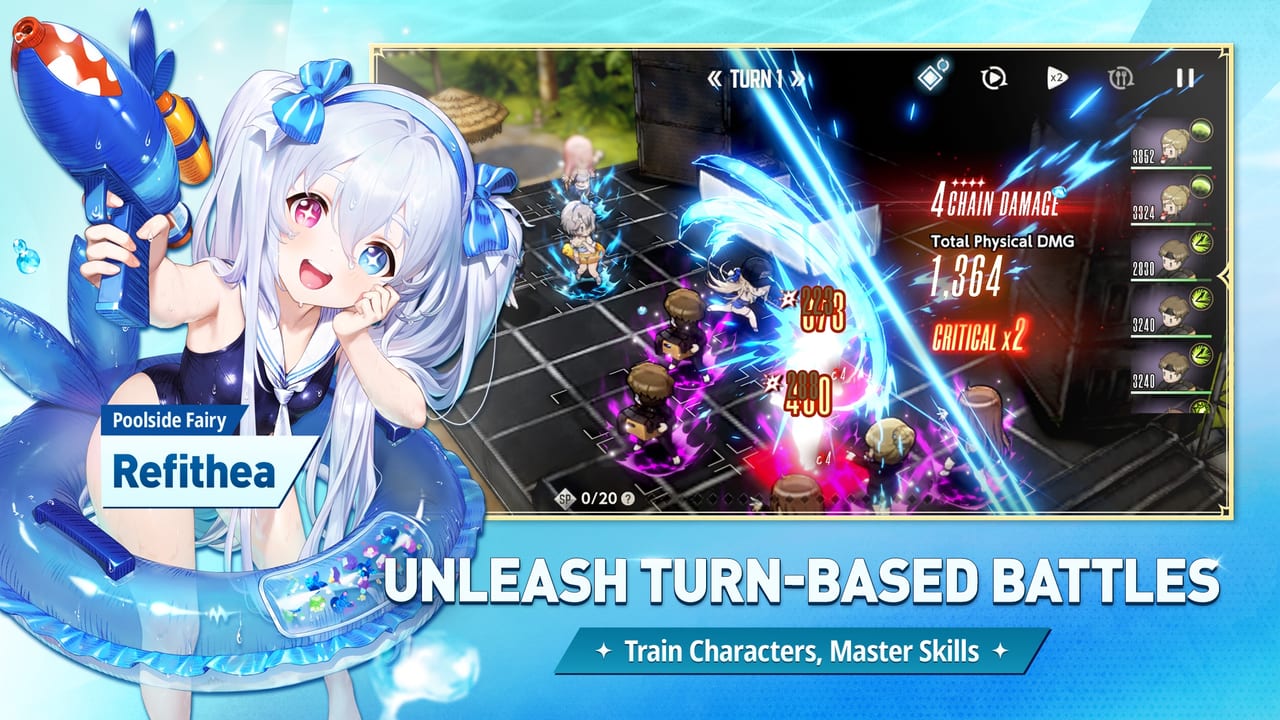
Every Brown Dust 2 fight uses the same board: three lanes, four tiles deep, five allies. You always act first. You drag chibi models onto tiles, drag names on the turn bar to pick order, then choose a basic attack, a knockback, or a costume skill. End turn, watch the resolution, then survive the enemy half. That is the whole verb set. Depth comes from shapes, SP, and chains, not from hidden combos.
If the lobby still feels like two games, finish getting started first. This page assumes you can enter a story stage.
The board
Your half is a 3x4 rectangle. The enemy half mirrors it. Skills do not use a free cursor; they fire a pattern from the caster’s tile — a plus, an X, a column, a row, a diagonal, a single front, a pierce. If the pattern does not overlap an enemy, you wasted the SP. That is why knockback exists: you shove a body into the pattern before the skill resolves.
You may rearrange during your turn. If an enemy telegraph covers a tile, walk off it before you confirm. Story packs teach this on elites; Fiend Hunter punishes it with raid-wide patterns.
Three actions per character
- Basic attack — default if you issue no order. Hits the nearest legal target, generates SP, applies a chain stack to the tile you hit.
- Knockback — pushes the nearest enemy on that logic one tile (some costumes push farther or hit extra bodies). The shoved unit takes 1 damage; the unit it collides with takes knockback damage that cannot miss. Chains apply to the main target, not always to the collision. Evade on the main target can deny the shove.
- Costume skill — the big pattern. Costs SP. Cooldown after use. Swap costumes mid-fight to use a second skill on the same character once the first is on cooldown. That swap is the entire costume system.
SP starts at a fight-specific value and ticks up each turn. Basics and some costumes generate more. Blowing your pool on turn one is how new Masters stall on bosses with 20+ SP gates.
Turn order is a combo recipe
Drag the list so that:
- Knockback or pull lines enemies into a shape.
- Buffs land before the nuke (ATK / MATK buffs are not the same bucket as vulnerability; see team building).
- Multi-hit chainers slap the boss before the main attacker.
- The carry skill hits last on a stacked tile.
If you leave the default order, your AoE often fires before the body is in the plus. Story trash forgives that. Fiend Hunter does not.
Chain damage
Each hit on an enemy tile adds a chain stack for that turn. Base damage is 100%. Each stack adds about 10% more to later hits on that same tile (skills can raise the per-stack value). Stacks reset when the turn ends. Multi-hit skills exist to climb the ladder faster. Chain-focused supports (Refithea, Celia, some Zenith costumes) exist because Fiend Hunter and Guild Raid scale with that ladder, not with a single fat number.
A short example: five hits on one elite is not five times the first hit. It is a ramp. If you spread five basics across five different trash mobs, you get five 100% hits and no ramp. For bosses, stack the tile. For story waves, spread only when you need to catch a wipe.
Some story bosses disable chains. Read the stage tooltip. Do not rebuild your whole PvE team because one pack turned the mechanic off.
Elements, fixed damage, crit
Units have a property (fire, water, light, dark, and so on). Hitting a weakness matters; hitting a resist wastes a plus rank. Fixed damage costumes (early Justia is the teaching example) ignore defense and also cannot crit. Use them to delete high-DEF story walls. Do not expect them to show the same crit screenshots as a physical carry.
PvE versus Mirror Wars
PvE wants buff diversity, chain, and a pattern that matches the boss weak points. Mirror Wars (async PvP) wants speed, disruption, and not getting one-shot on turn one. Separate ranks live on the PvP tier list. A story god can be a PvP passenger. Do not copy a Mirror defense team into Fiend Hunter.
Practice plan
- Replay an early elite. Only use knockback + one AoE. Watch bodies move into the plus.
- Same fight, drag turn order so the buffer acts first.
- Park everyone on one elite and count chain numbers.
- Then read team building and pick supports from players/supports.
When a YouTube clear looks impossible, it is usually plus ranks and gear, not a secret button. The tools hub and daily checklist are how those numbers grow while you sleep on the mechanic.
Frequently Asked Questions
Quick answers to the most common Brown Dust 2 questions.
How many characters do I bring into a Brown Dust 2 fight?
Five, on a 3x4 grid. Some modes change the rules; story, Evil Castle, and most events use five.
Why did my skill miss everyone?
The pattern did not overlap an enemy. Knock a body into the shape first, or walk the caster.
Do chain stacks last the whole battle?
No. They reset at the end of the turn unless a costume says otherwise.
Where should I practice before Fiend Hunter?
Story pack elites and the team-building guide. Then check the PvE tier list.